
by Vatican News
"To safeguard" is the key word: "To safeguard the communion that unites us, each person's talents, stories, encounters, goodness, beauty, and a perspective of salvation and redemption, even when everything seems to be going wrong." Through every form of communication, Christians are called to be "missionary disciples on the move, always journeying." But this journey differs from one that "reduces everything to calculation, business, and marketing." Instead, it means choosing "another way of seeing, telling stories, remembering, and building the future by narrating it."
This is the "other path" that Paolo Ruffini, Prefect of the Dicastery for Communication, proposed in his keynote address opening the Ninth National Meeting of Pascom (the Pastoral Communication Service of the National Conference of Bishops of Brazil) at the Shrine of Aparecida in São Paulo state on July 24. The meeting is titled Evangelization in Motion: The Pastoral Dimension of Communication.
The Challenges of Our Time
"We cannot stop, and we cannot lag behind the challenges of our time," Ruffini said. There is a direction to follow and a goal to reach, and it must be pursued together.
"It is time to build communion through every means of communication, to create collaborative projects, and to work with teams operating in different countries and cities in order to make visible the unity in which everything exists, to be ever more at one another's service, and to offer the world a global information system founded on the search for and sharing of truth."
In an extensive reflection on artificial intelligence, the Prefect observed: "Our communication has something great and unique about it: it does not sell abstract connections but real ones; it truly belongs to the world; it is driven not by economic interest but by the love of sharing what is good, true, and beautiful, offering it as a gift."
Communication grounded in self-giving and witness, he continued, "truly has the power to weave communion, connect people, enable them to share an experience, free them from isolation, and help them recognize themselves as part of a welcoming environment."
Communication as a Tool for Inclusion
Ruffini cited two concrete initiatives to illustrate how communication can become an instrument of inclusion and how stories can be "a powerful way to transform how we see one another."
The first was Dining Across the Divide, whose subtitle asks: Can breaking bread together help bridge differences? The second was Narrative4, whose motto is: "The shortest distance between two people is a story." For the Jubilee, this experience was proposed to 150 young people, who, in small groups, shared stories centered on the theme of "repair."
These initiatives bring together real people and create spaces where individuals can become part of a group and a community.
"Changing the narrative by orienting it toward hope, recognizing the dynamism of goodness, inspiring hearts, and directing them toward communion: this is the Christian leaven that the world so greatly needs," the Vatican Prefect emphasized.
The goal is a network designed not to entrap but to set people free, safeguarding a communion of free persons.
"The Church itself is a network woven by Eucharistic communion, where unity is based not on 'likes' but on the truth, on the 'Amen' through which each person adheres to the Body of Christ while welcoming others."
Educating People in the Use of Media
Among the dangers to avoid, Ruffini warned against misinformation spread in good faith, calling it "an unwitting multiplier of fake news and of the profits generated by it."
This type of connection, "based on indifference between truth and falsehood, gradually becomes habitual until people themselves become part of the mechanism. It is a form of hypnosis, a trap, a spider's web that imprisons us—the exact opposite of a network of knowledge and love that sets us free."
Artificial intelligence, while offering extraordinary opportunities for knowledge, can also generate ignorance disguised as knowledge, manipulation, and control.
"For this reason," he said, "formation is so important, so that people can discern, choose, and decide to remain masters of their own lives." Consequently, pastoral communication "must be grounded in education for the responsible use of media."
Changing the Paradigm
"If we wish to preserve our humanity," Ruffini continued, "technological innovation cannot be based on a disembodied understanding of the common good."
Drawing on one of the central messages of Pope Leo XIV's encyclical Magnifica Humanitas, the Prefect urged Catholic communicators to take action:
"We are living in a time of profound change. The question is whether we allow ourselves to be carried by the current or choose to guide change ourselves; whether we allow ourselves to become trapped in the net or cast the nets on the other side."
To embrace and overcome this challenge, he said, "we need a model that educates people to thirst, desire, and dream." This requires "changing the paradigm" by moving beyond "every form of technicism that reduces communication to mere connection, knowledge to easy and superficial answers, and education to a factory of immediate results that last only as long as the time it took to produce them."
"Communication is not simply the transmission of thoughts and feelings," he concluded. It is "the gift of oneself, inspired by love," and "the essential difference between machine communication and human communication lies precisely in the human capacity for self-giving—a capacity machines do not possess."
The Human Person at the Center
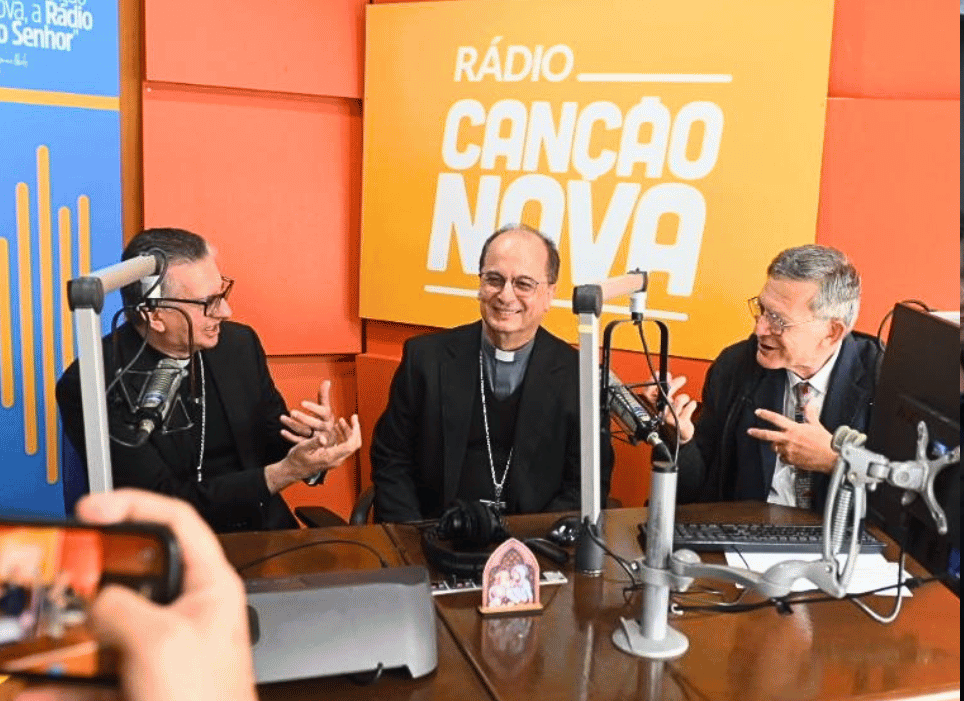
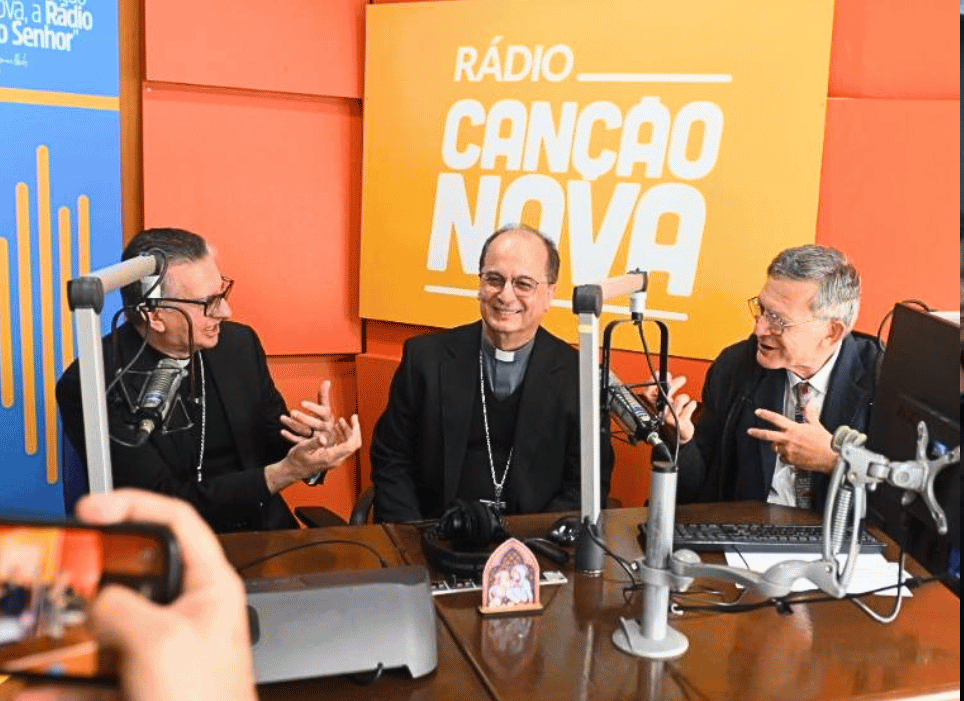
Following Ruffini's address, a panel discussion brought together the three bishops who serve on the Episcopal Commission for Social Communication: Bishop Valdir José de Castro, Bishop Edilson Soares Nobre, and Bishop Amilton Manoel da Silva.
Addressing approximately 1,500 delegates from across Brazil, the bishops reflected on the mission of pastoral communication in both the Church and contemporary society. Their dialogue explored current challenges and future perspectives, always beginning with communication's most fundamental dimension: the human person, whose dignity precedes every technological instrument.